
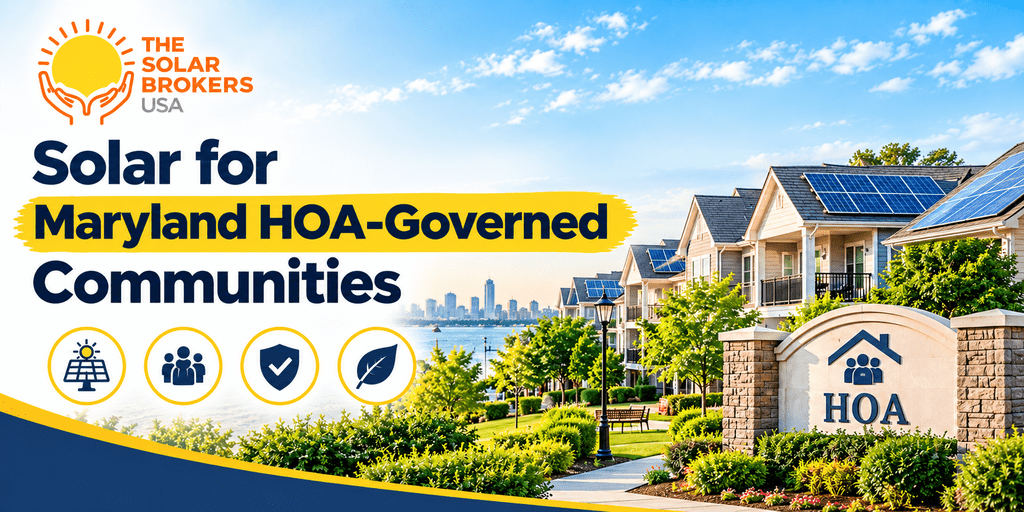
Homeowners living in HOA-governed communities across Maryland often wonder whether solar panels HOA Maryland restrictions could block a rooftop installation altogether. Homeowners associations are known for strict rules on exterior changes, and solar arrays sometimes fall into that category.
Fortunately, Maryland state law offers specific protections for residents who want to add solar energy systems, even when an HOA’s covenants suggest otherwise. Understanding these protections helps property owners move forward with confidence.
Maryland’s Solar Access Law
Maryland law prevents homeowners associations from enforcing outright bans on solar panel installations. Under the state’s solar easement and access statutes, HOAs cannot impose restrictions that significantly increase installation costs or substantially reduce system efficiency.
This means an HOA can request reasonable design guidelines, but it cannot use those guidelines as a backdoor way to prevent solar adoption entirely. The law was designed to balance community aesthetics with the state’s broader renewable energy goals.
What HOAs Can Still Regulate?
While outright bans are not allowed, HOAs retain some authority over how a system looks once installed. Common regulations include panel placement on less visible roof planes, frame color matching, and screening requirements for ground-mounted equipment.
Boards may also require advance notice or a simple application before work begins. These rules must stay reasonable and cannot be used to make installation impractical or unreasonably expensive for the homeowner.
Common Disputes and How They Arise
Conflicts often start when a homeowner submits a system that maximizes roof space for energy production, while the board prefers a smaller, less visible array. Disagreements can also surface over ground-mounted systems, fencing, or landscaping meant to screen equipment from the street. Most disputes are resolved once both sides reference the specific language in Maryland’s solar access statute, since it sets a clear boundary between reasonable aesthetic guidelines and restrictions that function as a ban.
Steps to Take Before Installation
Reviewing the HOA’s architectural guidelines early avoids delays later in the process. Submitting a complete application with system specifications, roof diagrams, and equipment details gives the board what it needs for a timely decision. Maryland law typically requires HOAs to respond within a set review period, so tracking submission dates matters. Keeping written records of all communication protects the homeowner if a dispute over solar panels and Maryland HOA regulations arises later in the approval process.
Choosing an Installer Familiar with HOA Rules
At Solar Broker USA, we have experience working within Maryland HOA communities and know how to anticipate common board concerns before they become obstacles.We design systems that satisfy both energy goals and aesthetic guidelines, including low-profile mounting hardware and panel layouts that reduce street visibility. We also help homeowners prepare documentation, which speeds up the association’s review and approval timeline.
Our team stays current on Maryland’s solar access regulations, so every design we propose already accounts for what local boards typically expect. We walk homeowners through each step of the process, from initial site assessment to final board sign-off, making sure nothing gets overlooked. This hands-on approach helps residents avoid delays and move toward a completed installation with fewer surprises along the way.
Balancing Aesthetics and Productivity
Many HOA boards are more receptive to solar installations when the design blends into the existing roofline rather than standing out. Sleek, black-on-black panel designs and conduit routed through less visible areas often satisfy both the homeowner’s energy needs and the community’s visual standards. Working collaboratively with the board, rather than treating the approval process as adversarial, tends to produce faster outcomes and stronger long-term relationships within the community.
Conclusion
Maryland’s legal protections give homeowners in HOA communities a clear path toward solar adoption, even when covenants raise initial concerns. By understanding what associations can and cannot restrict, preparing thorough applications, and working with installers experienced in HOA approvals, residents can move forward with a system that meets both energy and community standards. Solar Broker USA also supports commercial solar Maryland projects for businesses looking to make a similar transition.
FAQs
Can an HOA legally ban solar panels in Maryland?
No. Maryland law prohibits HOAs from enacting outright bans on solar panel installations for residential properties.
What can an HOA still require for solar installations?
Reasonable design guidelines, such as panel placement or frame color, as long as they don’t significantly raise costs or reduce efficiency.
How long does HOA approval typically take?
Maryland law sets a review period HOAs must follow, though exact timelines can vary by association bylaws.
Can Solar Broker USA help with the HOA approval process?
Yes. We prepare the documentation and system designs HOA boards need to review applications quickly, helping homeowners move through approval without unnecessary delays.