
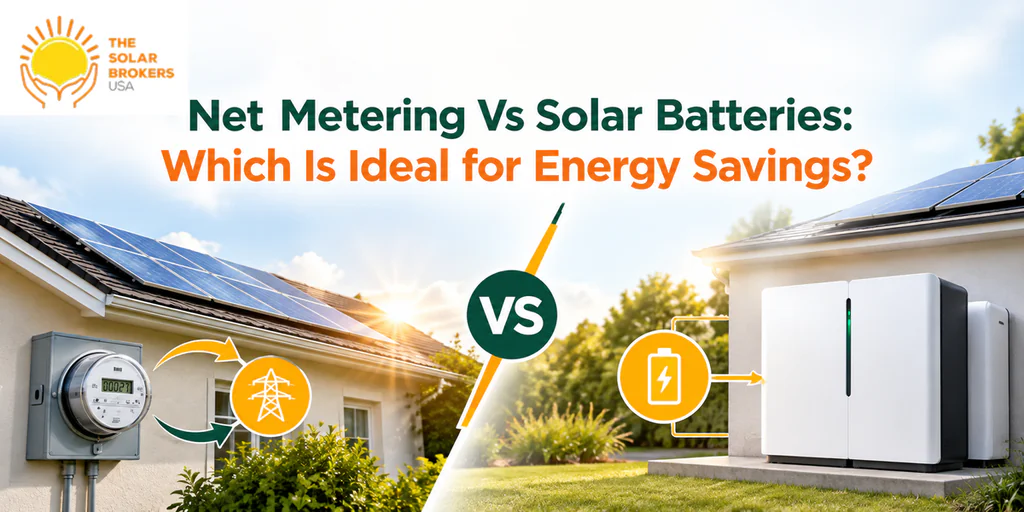
As solar energy adoption keeps growing across the United States, businesses and homeowners are facing an important decision: Should you depend on net metering or invest in solar battery storage? Though both options offer different benefits, the right choice always depends on your energy goals, location, and long-term financial strategy.
You may make a smarter and cheaper investment by learning how each system works and how they affect your savings. In this blog, you’ll learn more about the differences between solar batteries and net metering to understand which is ideal for energy savings.
What Is Net Metering?
Net metering is a utility program allowing solar panel owners to send excess electricity back to the grid in exchange for credit bills. When your solar panels make more energy than you consume, the extra energy is sent back to the power grid, and your utility company pays credits based on its net metering policy.
In many states, these credits are worth around the same as the retail price of electricity, making net metering an appealing way to lower monthly utility expenses. Basically, the grid works like a “virtual battery,” letting you use energy when the solar system isn’t making it or your household consumes more energy than solar panels produce.
What Are Solar Batteries?
Solar battery storage lets you store electricity generated by your solar system for later use. Rather than sending unused energy to the grid, you can keep excess energy on-site and use it when required.
This method gives you more control over how much energy you use. Batteries are very helpful when there is a power cut, or when utility companies don’t pay much for exported energy. They also help homes become less dependent on the grid, giving more energy independence.
Comparing the Financial Benefits
Before you opt for solar installation, know that, from a purely financial standpoint, net metering often provides a faster ROI. This is especially true in states where utilities offer full retail credit for exported energy. Since there is no need for extra hardware such as batteries, the upfront cost is lower, and the payback period is usually shorter.
But the value of net metering depends a lot on local policies. In areas where utilities offer much lower compensation rates, the financial advantage decreases a lot. Though solar batteries are more expensive upfront, they let you use stored energy during peak periods when energy costs are the highest. With time, this can lead to meaningful savings, and this is particularly in regions with time-of-use (TOU) pricing structures.
Why Net Metering Makes More Sense
Net metering is usually the better choice when your utility offers stronger incentives and more favorable compensation rates. It is perfect for organisations and homeowners that want to spend as little as possible up front and save as much as possible right away.
In these cases, the grid takes the position of a battery, so you can use solar energy without having to buy extra equipment. This means that net metering is a useful and effective option for most conventional solar systems.
When Solar Batteries Become the Ideal Option
Solar batteries become more valuable in situations where net metering policies are not favored much. If your utility offers low compensation for exported energy, storing electricity for personal use can enhance the chances of improving your overall savings.
Batteries are also important for people who want to be energy independent. They protect against growing electricity rates or changes in utility policy in the future, and they give you power when the power goes off. This extra stability might be a big plus for businesses or homeowners in locations with grids that don’t always work.
Important Considerations Beyond Cost
Though financial return cannot be ignored, other factors influence your decision. Net metering doesn’t provide backup power during outages, as most solar panels in Maryland shut down when the grid becomes offline for safety reasons. But batteries, on the other hand, can keep your lights on and important systems running.
Policy stability is another consideration. Utility regulations can change with time, potentially reducing net metering’s value. Battery storage offers a unique level of protection against these uncertainties by letting you depend more on your own energy.
The Best Solution: A Hybrid Approach
In most cases, the most effective solution is a combination of net metering and battery storage. This hybrid approach lets you maximize your savings while also benefiting from backup power and energy independence. You can make your system work better for both short-term savings and long-term resilience by exporting extra energy when it’s useful and storing it when it’s not.
Bottom Line
There is no one-size-fits-all answer to the question of whether to use net metering or solar batteries. It all relies on the rules of your local utility, how you use energy, and your long-term goals. Batteries give you control, reliability, and independence, but net metering is easier and gives you faster financial rewards. Making an informed choice will greatly increase the value of your solar investment, ensuring you get the most out of your system for many years to come.
Connect with Solar Brokers today to identify the most effective solar solution for your needs and get relevant guidance on maximizing your energy savings and long-term return.